Bringing Addiction Care to the Streets of Chicago
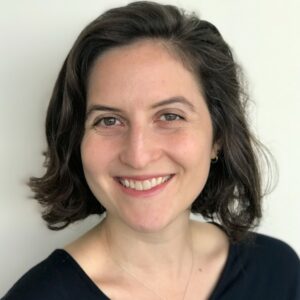 When Dr. Sarah Messmer moved back to her hometown of Chicago after medical training at Harvard and Massachusetts General Hospital, she didn’t plan to spend her career working out of a van. But it didn’t take long for her to realize that was exactly where she needed to be.
Today, as an addiction medicine physician at the University of Illinois Chicago (UIC), Messmer runs a low-threshold substance use treatment program that delivers care directly to people where they already are—on the streets and at syringe service sites on the city’s West and South Sides. Her team is based within the Community Outreach and Intervention Projects (COIP) at the UIC School of Public Health, a program founded in 1986 that employs community members with lived experience to deliver overdose prevention services.
“The West Side has the highest overdose death rates in Chicago,” Messmer explained. “And I was seeing how much none of our patients would go anywhere else for care. So, how do we implement the care people need in the settings where they’re actually coming?”
What began as an effort to integrate primary care into a syringe service program quickly evolved into something larger. With funding secured in 2021, Messmer helped launch a mobile unit capable of dispensing buprenorphine on-site—a critical step for patients facing barriers to accessing medications for opioid use disorder. The ability to provide care and medication in one place, without requiring clinic follow-ups, changed everything.
“People loved it,” she said. “We thought we’d start them on treatment and link them to a brick-and-mortar clinic for ongoing care, but people wanted to keep coming back to the van.”
The patients who return are primarily men in their 40s and 50s, many of whom use opioids by snorting rather than injecting and often use cocaine as well. For Messmer, these realities challenge the assumptions that underlie much of traditional addiction medicine—and demand a rethinking of how and where treatment happens.
That insight led her to her current career development award (K award) project: exploring how contingency management (CM)—a behavioral strategy proven to support treatment retention—can be adapted for overdose prevention settings like the COIP mobile units. “CM is very effective, but it can be hard to implement,” she said. “Our question is how to do it here, in a mobile unit.”
Through a series of qualitative interviews with patients and staff, Messmer is designing a CM model focusing not on abstinence but on engagement, trust, and stability. “It’s been really interesting to ask, ‘Do people want us to do this here?’” she said. “They do.”
For Messmer, the work is deeply personal. Her path from aspiring physicist to addiction medicine physician mirrors her belief in experimentation, data, and real-world problem-solving.
And as she balances her research, practice, and life at home with her wife, five children, and two backyard chickens named Patty and Monarch, her commitment remains clear: meet people where they are, and build the system around them.
“I couldn’t be doing any of this without the COIP team,” she said. “They’ve been doing this work in the community for almost 40 years. I’m just grateful to be part of it.”
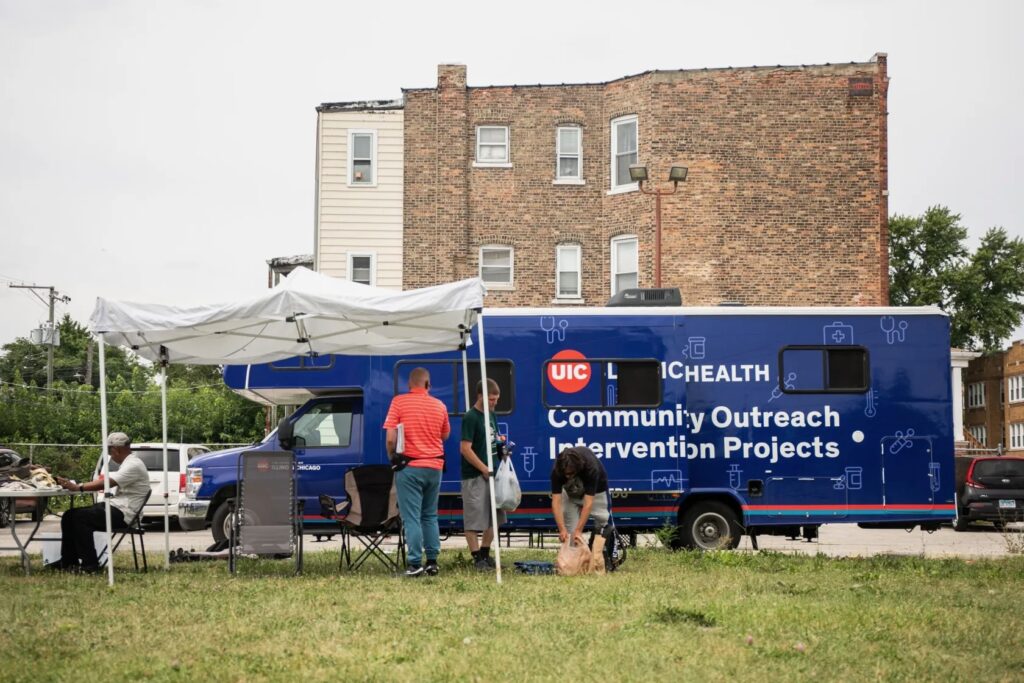
UIC Community Outreach Intervention Projects mobile clinic on Chicago’s West Side. Photo: Pat Nabong / Chicago Sun-Times.