Dr. Crystal Smith’s path into addiction science didn’t begin in a lab or clinic. It began in a rural logging town in northern Idaho, a community shaped by poverty, limited opportunity, and the kinds of challenges that can derail a young person before adulthood. Smith understands this firsthand.
Growing up in that environment, she experienced the same struggles many young people in underserved communities face. “Like many youth do in these situations,” she said, “I found myself struggling early on.”
When she became a young single mother, Smith worked relentlessly to support her daughter — piecing together long hours, surviving instability, and seizing every opportunity that could move her forward. “Through a lot of self-determination and luck — truly a lot of luck — I was able to pull out of this situation,” she said.
That turning point led her into clinical work, which opened the door to graduate school and ultimately to her PhD. But even that wasn’t the end of the story. “I achieved my PhD and didn’t feel like that was enough,” she said. “So I kept myself even busier with consulting.”
Today, Smith is an assistant professor at Washington State University and the founder of the Laboratory for Innovations and Therapeutics, a research program she launched this year. At the center of her portfolio is her NIDA-funded K01 award, which examines how pharmacogenomic testing can improve opioid use disorder treatment. She recently completed Aim 1, identifying the barriers and facilitators to pharmacogenomic testing in opioid use disorder treatment settings, and is preparing to launch Aim 2. “Next year we’ll move on to developing and evaluating educational resources based on what we learned,” she said. “These will be for providers, patients and staff.”
Her research extends far beyond a single grant. Smith is running a clinical trial on varenicline for cannabis use disorder and collaborating on psilocybin safety research for PTSD and alcohol use disorder. Much of her consulting work is also rooted in the psychedelics field. Looking ahead, she noted, “My hope is that the next step will be testing and then scaling my K01 work into a large-scale clinical trial.”
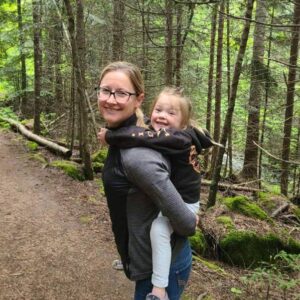
Outside the lab, Smith’s life is full. Her oldest daughter, now 24, is in flight school in Arizona. Her younger daughter, 8, is immersed in competitive gymnastics. She’s also an outdoor enthusiast. “Hiking, biking, skiing, mountain biking… basically that’s my life,” she said. And then there are her dogs: “I’m in love with my doodles,” she said. “You will hear too much about them if you talk to me.”
Reflecting on her journey, Smith summed it up simply:
“From lived experience to addiction science, from survival to innovation, and now from clinical research to implementation science.”
Her path reshapes assumptions about who becomes a scientist and who leads innovation in substance use treatment. And it underscores what drives her work: a commitment to building solutions that work not just in theory, but in the real-world settings where people seek care.