Closing the Distance Between What We Know and What We Do
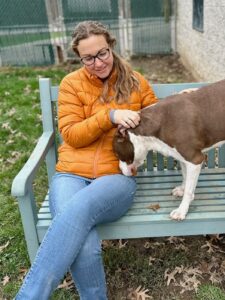 Berkeley Franz came to her work on health disparities through an unlikely door. After earning a master’s in religious studies at the University of Chicago, she went on to complete a PhD in medical sociology at the University of Miami, drawn by a curiosity about why people seek care and whether they trust the systems meant to help them.
“I’ve always been really fascinated by how people decide to seek medical care, and what role their own background and worldview play,” Franz says. That curiosity eventually led her to the opioid epidemic and an ongoing problem she couldn’t let go of.
Early in her career, Franz came face-to-face with what she describes as a puzzle. Buprenorphine, a medication for opioid use disorder that saves lives, was being prescribed by fewer than 10% of healthcare professionals. The gap between what the evidence showed and what clinicians were willing to do became the foundation of her research, examining how stigma and physician bias, not just patient-level barriers, limit access to evidence-based opioid treatment.
In rural communities, that reluctance runs especially deep. Franz argues the field has underestimated how deeply the prescription opioid epidemic damaged rural clinicians’ trust. Many watched their patients suffer while pharmaceutical companies operated unchecked, and that experience left lasting skepticism toward anything connected to opioid prescribing. Her research has found that nearly half of rural clinicians endorse a myth about treating opioid use disorder, and misinformation is only part of the problem.
“There’s a fear that they’re going to open the floodgates if they start offering addiction treatment,” she says. “But I think those people are actually already in their exam rooms if they’re willing to ask the questions.”
To address those fears, Franz and her team use social contact as an implementation strategy, grounded in decades of research showing that proximity and personal exposure reduce stigma more effectively than information alone. In practice, that means connecting hesitant providers with peers who have already integrated addiction treatment into their primary care practice, through videos, training programs, and long-term mentorship. The goal is to show that treating opioid use disorder is not only possible but professionally safe.
“The C-DIAS fellowship was really transformative, it came at a really important time in my career. I’m at a pretty small rural institution, and there’s nobody here doing implementation science. C-DIAS provided a network of now great friends and collaborators that have really improved the work that I do.”
Franz wants rural patients to be able to receive care for substance use disorders in primary care settings, without the stigma or inconvenience of seeking specialized treatment elsewhere. “Anybody should be able to receive care in a less stigmatizing environment,” she says.
The urgency is personal. “I’m somebody who’s lost people from opioid overdoses in my life, and I sometimes feel like we’re not doing the work fast enough.”
When she’s not working, Franz and her husband are making their way through the national parks, with a recent stop at Capitol Reef in Utah after attending the Addiction Health Services Research annual meeting. Back home, she serves on the board of a local animal shelter, helping connect dogs with rescue networks in larger cities where adoption rates are higher.