Posts by Cory
Hannah Begna, MS

Hannah Begna, MS, is a research data analyst at C-DIAS. Hannah has dedicated her career to advancing public health and academic research, with experience spanning communicable diseases, HIV, women’s health, and mental health. She holds a bachelor’s degree in kinesiology from the University of Western Ontario and a master’s in global health sciences from the…
Read MoreBryan Chauvel, MS

Bryan Chauvel, MS, is the communications director at C-DIAS, bringing extensive experience in comprehensive marketing and communications. Previously, he led communications at St. Anthony Foundation, where he enhanced the organization’s profile through strategic storytelling, strengthened fundraising efforts, and ensured brand consistency across diverse channels. His background includes roles at Google, Williams-Sonoma, and over 15 years…
Read MoreNEW! Article Infographics: Translating Research into Action
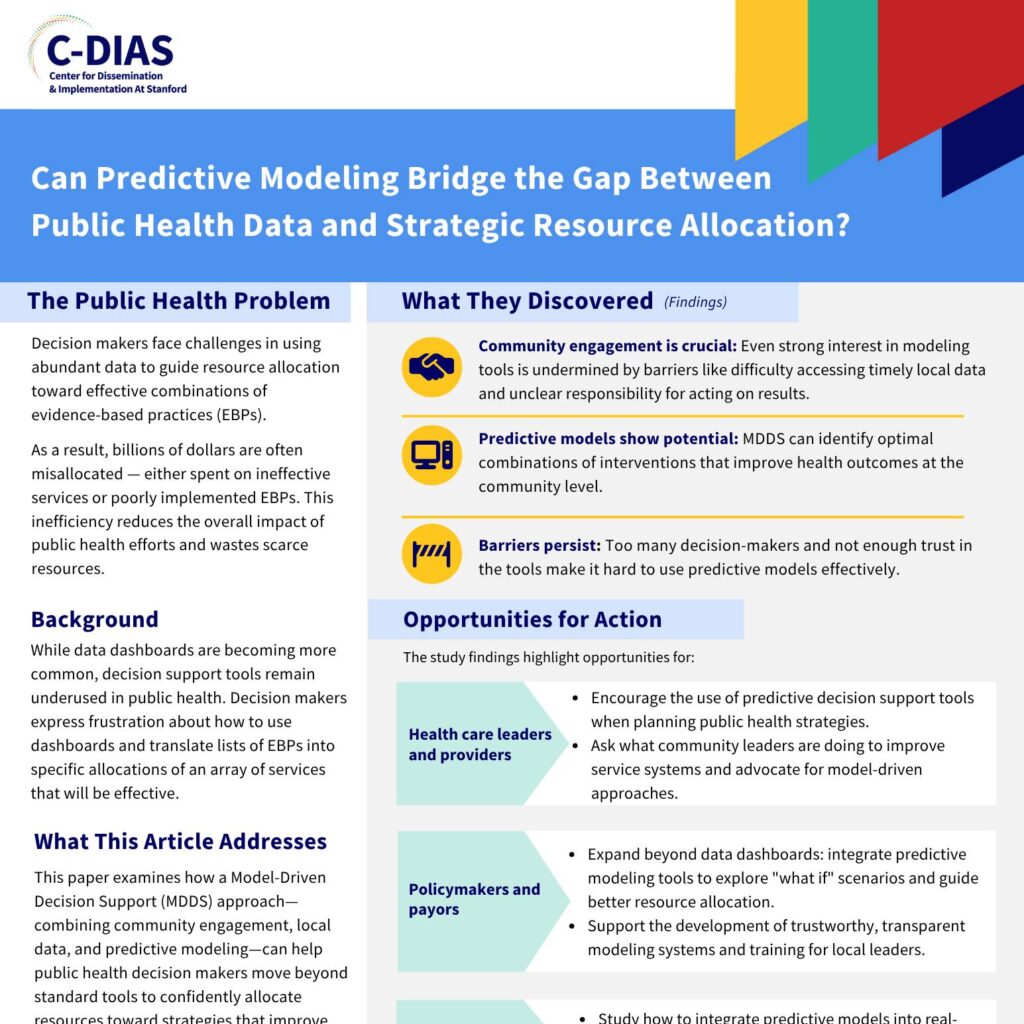
C-DIAS is proud to launch a new series of article infographics—visual tools designed to distill key findings from implementation research and support the spread of effective health care strategies. These infographics make it easier to understand and apply evidence-based practices across systems of care. Stay tuned for our upcoming online publication library, where you’ll find…
Read MoreMethods for Rescuing Implementation Trials that Have Gone Off the Rails
Geoffrey Curran, PhD, JD Smith, PhD, Alison Hamilton, PhD | May 27, 2025: Implementation trials frequently run into unanticipated challenges which, if not successfully addressed, can threaten their integrity and derail implementation quality and speed. These problems, and potential solutions, remain largely tacit. In this panel, 4 principal investigators describe how their extramurally-funded implementation trials…
Read MoreMaintaining Efficacy while Adapting Contingency Management: State and Tribal Partnerships as Examples
Sara Parent, N.D., K. Michelle Peavy, Ph.D., Kait Hirchak Ph.D. | May 13, 2025: Contingency Management (CM) is an evidence-based behavioral intervention for substance use disorders that is receiving increasing attention as the most effective treatment available for stimulant use disorder. Decades of research have established its efficacy, and more recent Dissemination and Implementation Science…
Read MoreRollout Trial Designs in Implementation Research are Often Necessary and Sometimes Preferred

Background: Rollout designs, which include stepped wedge designs, are defined by staggered implementation of new or alternative programs or services. Critiques of stepped wedge and other rollout designs have raised concerns regarding the confounding of true implementation or program effects with unrelated, global changes in service delivery, with some recommending they only be used when…
Read MoreThe Difference-Making Role of Staff Support in Implementing Nurse Care Management for Opioid Use Disorder Treatment: A Configurational Analysis.

Introduction: Understanding conditions in which interventions succeed or fail is critical. The PRimary care Opioid Use Disorders treatment (PROUD) trial, a cluster-randomized hybrid study, tested whether implementation of office-based addiction treatment supported by a nurse increased medication of OUD. Six health systems each provided two primary care (PC) clinics that were randomly assigned to implement…
Read MoreA Framework for Designing Hybrid Effectiveness-Implementation Trials for Digital Health Interventions

This article proposes methods for designing randomized controlled trials studying the implementation and effectiveness of digital interventions, meaning websites or applications (“apps”) that patients use in healthcare. Deploying digital interventions for behavioral health differs from implementing traditional interventions such as medications or human-delivered therapy. Prior trial design guidance has ignored the existence of international governmental…
Read MoreEffectiveness of Mutual Health Groups for Illicit Drug Use Disorders: A Review of the Current Literature
Purpose of Review: Evaluate literature examining whether mutual help groups (MHGs) for illicit drug use disorders benefit participants. Recent Findings: Recent studies consistently show that MHG attendance and involvement predict reductions in drug use and addiction severity. More rigorous methodologies offer stronger evidence of effectiveness, but additional controlled trials are needed. Drug-focused MHG challenges include…
Read MoreUS Payment Policy for Medications to Treat Opioid Use Disorder: Landscape and Opportunities

Offering patients medications for opioid use disorder (MOUD) is the standard of care for opioid use disorder (OUD), but an estimated 75%–90% of people with OUD who could benefit from MOUD do not receive medication. Payment policy, defined as public and private payers’ approaches to covering and reimbursing providers for MOUD, is 1 contributor to…
Read More